

The Picture of Dorian Gray, like most novels, derives its character from the life of its author. At the same time, the art as a window into the author’s soul. In the case of this novel, it seems Oscar Wilde has infused his life into his art. As he states in its preface, “Vice and virtue are to the artist materials for an art.” If this is true, Wilde had substantial material to draw from between his dysfunctional marriage, lectures on Aestheticism, intelligent upbringing, flirtation with Catholicism, interest in forward fashion, and gay love affair. During a time known for its societal restrictions, Wilde broke the constraints superimposed by his superego time and time again, although because of the philosophy ingrained in his works, I propose that his ego was very well developed. In understanding the metaphorical dialogue between the superego and the id, Wilde was able to write a masterful novel addressing the most graphic extremes of each, satirizing both sides of man, and building a tension between the two that illustrates the necessity of the ego. But enough about Freudian Theory.
Psychoanalysis of my newly favorite author…
The ideas put forth by his novel tell a great deal about Oscar Wilde. In the very beginning of the book, the unhappy union between he and his wife is reflected in Lord Henry’s description of his marriage:
[T]he one charm of married life is that it makes a life of deception absolutely necessary for both parties. I never know where my wife is, and my wife never knows what I am doing. When we meet… we tell each other the most absurd stories with the most serious faces. My wife is very good at it– much better, in fact, than I am. She never gets confused over her dates, and I always do. But when she does find me out, she makes no row at all… she merely laughs at me.
(Wilde page 6)
The marriage between Lord and Lady Henry Wotton is strained and dispassionate, but absolutely necessary as matrimony and heirs were heavily pushed, if not compulsory, during the time period. While it is nearly directly stated that Lord and Lady Wotton have an open relationship, other portions of the text indicate that Lord Henry has both female and male lovers. Similarly, Wilde felt confined in his marriage despite the love he bore his wife and sons and engaged in several extramarital affairs with other men, most notably Lord Alfred Douglas. The letters of Constance Lloyd, Oscar Wilde’s wife, show that she was very compassionate towards him as she was no more enthused than he about their social obligations and valued the independence offered by supporting his romantic endeavors. The biography published by Fanny Moyle asserts that Oscar and Constance had a marriage of equals in which Oscar supported Constance’s enthusiasm for women’s rights and Constance aided in his writing, among other collaborative lifestyle choices. Constance Lloyd became a pariah after Wilde was found guilty of sodomy, but visited him while he was imprisoned and payed for his expenses upon his release. Even after Constance died in 1898, Wilde would visit her grave and leave flowers. Regardless of the estrangement they suffered romantically, it is evident that they cared a great deal for one another and even loved each other passionately despite the marriage’s failure in a traditional sense and the loss of the original attraction they felt.

While the marriage of Lord and Lady Wotton seems to appropriately shadow Wilde’s life, Lord Henry’s condescending statements regarding women such as, ‘”My dear boy, no woman is a genius. Women are a decorative sex. They never have anything to say, but they say it charmingly'” paint a complex portrait (Wilde 46). After all, Constance co-authored many of the children stories the couple published during the early years of their marriage. However much Wilde favored women’s rights, it is conceivable that he would harbor contempt towards women because of the strict laws enforced in 1885 regarding sexuality. In addition, as I have stated in my previous entry “Lord Henry the Narcissist and his Psychotic Protege”, Henry is an exaggeration of Wilde’s natural concupiscence, an expression of the id, rather than the true reflection of Wilde’s opinion.

Another facet of Wilde’s life that resonates in his novel is Aestheticism, both towards sensuality and beauty. The lush, luxurious imagery incorporated throughout the novel draw the reader towards “art for the sake of art” while the ideas proposed by Lord Henry and manifested by Dorian Gray illustrate the pursuit of pleasure in fulfillment of life’s potential. Henry introduces Dorian to “a novel without a plot and with only one character, being, indeed, simply a psychological study of a certain young Parisian who spent his life trying to realize in the nineteenth century all the passions and modes of thought that belonged to every century except his own” (Wilde 120). After obsessively rereading the novel (whose description is strikingly similar to The Picture of Dorian Gray itself), Dorian Gray comes to believe that sin is wrongly restricted and “there was to be, as Lord Henry had prophesied, a new Hedonism that was to recreate life to save it from that harsh uncomely puritanism” (Wilde 125). Essentially, Dorian believes that man should ignore society’s normative morals if what is thought to be immoral gives him pleasure. In this way, Wilde jabs at the laws and societal expectations he finds oppressive, and challenges the status quo.
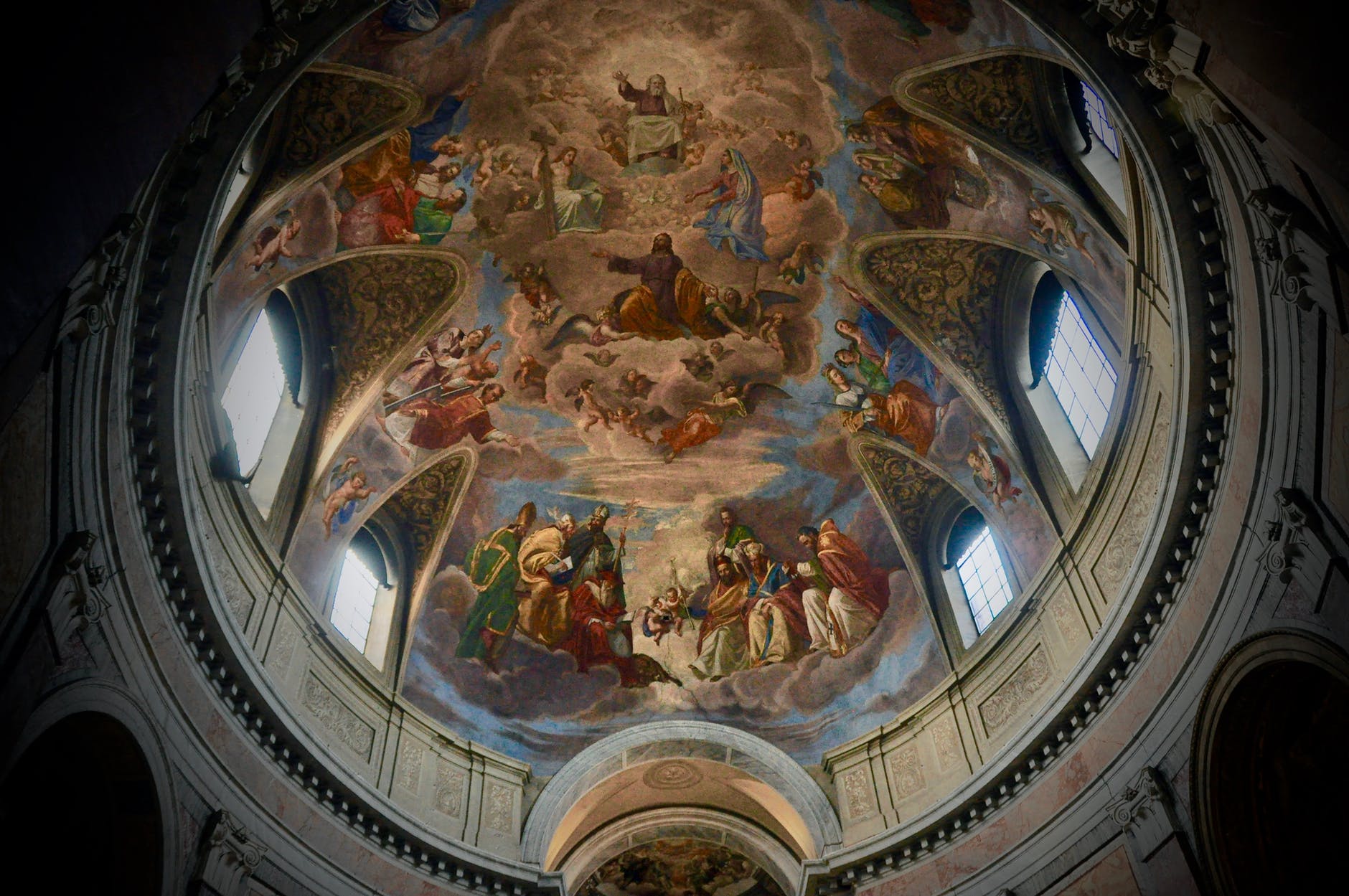
Finally, Wilde projects his own fascination with Catholicism into Dorian’s admiration for Catholicism when he writes, “It was rumored of him once that he was about to join the Roman Catholic communion, and certainly the Roman ritual had always a great attraction for him” (127). Demonstrating how deeply drawn he was to the Church, Wilde goes on to write, “He loved to kneel down on the cold marble pavement and watch the priest… raising aloft the jewelled, lantern-shaped monstrance with that pallid wafer that at times, one would think, is indeed the “panis caelestis”, the bread of angels, or robed in the garments of the Passion of Christ, breaking the Host into the chalice and smiting his breast for his sins” (127). Wilde beautifully describes mass and the theological and mystical elements to which he was drawn, and unlike Dorian, would eventually convert to Catholicism. Despite being drawn to the Church for most of his life, like St. Augustine prior to conversion he did not yet feel ready to change his lifestyle; as a result, he had a deathbed conversion.
Work Cited
Beckson, Karl. “Oscar Wilde.” Encyclopædia Britannica, Encyclopædia Britannica, Inc., 5 Feb. 2019, http://www.britannica.com/biography/Oscar-Wilde.
Boundless. “Boundless Psychology.” Lumen Learning, Lumen, courses.lumenlearning.com/boundless-psychology/chapter/humanistic-perspectives-on-personality/.
Britannica, The Editors of Encyclopaedia. “Aestheticism.” Encyclopædia Britannica, Encyclopædia Britannica, Inc., 26 Oct. 2018, http://www.britannica.com/art/Aestheticism.
Burton, Neel. “The Two Types of Psychopath.” Psychology Today, Sussex Publishers, http://www.psychologytoday.com/gb/blog/hide-and-seek/201901/the-two-types-psychopath.
Person. “15 Pieces Of Style Advice From Oscar Wilde.” ShortList, ShortList, 5 May 2014, http://www.shortlist.com/style/15-pieces-of-style-advice-from-oscar-wilde/32919.
Romantic Circles, Romantic Circles, http://www.rc.umd.edu/sites/default/RCOldSite/www/rchs/reader/tabbey.html.
Seymour, Miranda. “Constance: The Tragic and Scandalous Life of Mrs Oscar Wilde by Franny Moyle – Review.” The Guardian, Guardian News and Media, 24 June 2011, http://www.theguardian.com/books/2011/jun/24/constance-mrs-wilde-franny-moyle-review.
Wilde, Oscar. The Picture of Dorian Gray. 1890. Barnes & Noble, Inc., 2015.
Wordsworth, William. “Lines Composed a Few Miles above Tintern Abbey, On Revisiting the Banks of the Wye during a Tour. July 13, 1798 by William Wordsworth.” Poetry Foundation, Poetry Foundation, http://www.poetryfoundation.org/poems/45527/lines-composed-a-few-miles-above-tintern-abbey-on-revisiting-the-banks-of-the-wye-during-a-tour-july-13-1798.
 The Picture of Dorian Gray